
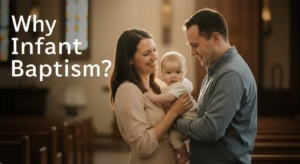
Why Infant Baptism?
The practice of infant baptism stands as one of the most significant and often debated rites within Christianity. For many, it is a cherished tradition, a beautiful expression of God’s grace and the inclusion of children into the covenant community. For others, particularly those from traditions emphasizing “believer’s baptism,” it raises questions about personal faith, choice, and the scriptural basis for baptizing those who cannot yet profess belief. This comprehensive exploration aims to delve into the rich theological, historical, and scriptural foundations that underpin the practice of infant baptism, seeking to provide clarity and understanding for those who embrace it and those who seek to comprehend its rationale.
Understanding Infant Baptism
Defining Infant Baptism
At its core, infant baptism is the Christian sacrament or ordinance of baptizing infants or young children. This practice typically involves the application of water (by sprinkling, pouring, or immersion) in the name of the Father, Son, and Holy Spirit, often performed by a minister or priest within a church service. Unlike believer’s baptism, where the individual makes a conscious, public profession of faith before being baptized, infant baptism is administered to those who are too young to articulate such a profession. It is usually undertaken by Christian parents or guardians who commit to raising the child in the Christian faith.
This act is not seen as guaranteeing salvation, but rather as a sign and seal of God’s covenant promises, marking the child as belonging to the visible church and a recipient of God’s initiating grace. It anticipates a future, personal response of faith, which is nurtured through Christian upbringing and often publicly affirmed in rites like confirmation or a profession of faith later in life.
The Core Question: “Why Infant Baptism?”
The question “Why infant baptism?” is fundamental for understanding this practice. It challenges us to look beyond mere tradition and explore the deeper theological and scriptural reasons that have sustained it for centuries across a significant portion of global Christianity, including Roman Catholicism, Eastern Orthodoxy, Anglicanism, Lutheranism, Presbyterianism, Methodism, and many other Reformed traditions. The inquiry often stems from a desire to reconcile the practice with New Testament accounts that frequently depict adults being baptized after hearing the Gospel and expressing faith. To answer this, we must examine the continuity of God’s covenant, the nature of salvation by grace, the role of the family in faith formation, and the corporate identity of the Church. It requires a journey through both testaments, early church history, and systematic theology to appreciate the full scope of its meaning.
Historical and Scriptural Foundations for Infant Baptism
The arguments for infant baptism are not solely based on tradition but are deeply rooted in a particular interpretation of Scripture and the historical development of Christian practice.
Old Testament Precedents and Covenant Theology
A primary foundation for infant baptism lies in the Old Testament concept of covenant and the practice of circumcision. God established a covenant with Abraham, promising to be God to him and his descendants (Genesis 17:7). The sign of this covenant was circumcision, which was commanded to be performed on male infants eight days old (Genesis 17:12). This was a sign of inclusion in God’s people, a mark of belonging to the covenant community, regardless of the infant’s ability to understand or consent.
Covenant theology posits a fundamental continuity between the Old and New Covenants. While the outward signs change, the underlying reality of God’s gracious covenant with His people remains. Just as circumcision marked infants as part of the Old Covenant community, infant baptism is understood by many as the New Covenant sign of inclusion for the children of believers. It signifies the spiritual reality of new birth and cleansing, pointing forward to the child’s future appropriation of faith. The inclusivity of God’s covenant, extending to children, is a consistent theme throughout the Old Testament, where children were always considered part of the community of faith and beneficiaries of God’s promises.
New Testament Implications and Household Baptisms
While the New Testament does not contain an explicit command for infant baptism, proponents argue that it provides strong implications and patterns consistent with the practice.
Firstly, Jesus’ welcoming of children is often cited (Matthew 19:14, Mark 10:14, Luke 18:16), where He declares, “Let the little children come to me and do not hinder them, for to such belongs the kingdom of heaven.” This demonstrates Jesus’ embrace of children and their place within the scope of God’s kingdom, implying their inclusion in the new covenant community.
Secondly, and perhaps most significantly, are the accounts of “household baptisms” in the Book of Acts and Paul’s epistles. We read of Lydia and her household (Acts 16:15), the Philippian jailer and his household (Acts 16:33), and the household of Stephanas (1 Corinthians 1:16) all being baptized. In a patriarchal society where the head of the household made decisions for the entire family unit, the term “household” (Greek: oikos) would almost certainly have included children, and even infants. If children were excluded, it would be a notable departure from the Old Testament covenant pattern where children were explicitly included, and such an exclusion would likely have warranted specific mention. The absence of any explicit instruction to exclude children from baptism, coupled with the inclusive nature of “household” baptisms, is seen as strong circumstantial evidence for the practice.
Furthermore, Peter’s sermon on Pentecost (Acts 2:38-39) proclaims, “Repent and be baptized every one of you in the name of Jesus Christ for the forgiveness of your sins, and you will receive the gift of the Holy Spirit. For the promise is for you and for your children and for all who are far off—everyone whom the Lord our God calls to himself.” This passage explicitly extends the promise of salvation and the gift of the Holy Spirit to “your children,” reinforcing the idea of generational inclusion in God’s covenant.
Early Church Practice of Infant Baptism
Moving beyond scriptural implications, historical evidence strongly suggests that infant baptism was a widespread practice in the early church, certainly by the second and third centuries, if not earlier.
- Irenaeus (c. 130-202 AD): In Against Heresies, he speaks of Christ coming “to save all through means of himself—all, I say, who through him are born again to God—infants, and children, and boys, and youths, and old men.” While not explicitly mentioning baptism, “born again to God” was often synonymous with baptism in early Christian discourse.
- Tertullian (c. 160-220 AD): While he advocated for delaying baptism (especially for unmarried individuals and children) until maturity due to concerns about post-baptismal sin, his argument against infant baptism in certain circumstances ironically confirms that the practice was already common in his time. If it wasn’t practiced, he wouldn’t have needed to argue against it.
- Origen (c. 185-254 AD): In his Commentary on Romans, he explicitly states, “For this reason, the Church received from the Apostles the tradition of baptizing infants.” He links it to the belief in original sin and the need for spiritual cleansing from birth.
- Hippolytus (c. 170-235 AD): His Apostolic Tradition, a significant early church order, provides detailed instructions for baptism, including provisions for children and infants, stating that “they shall speak for themselves” or “their parents or someone else from their family shall speak for them.”
By the time of Augustine of Hippo (354-430 AD), infant baptism was universally accepted and considered an apostolic tradition, primarily due to the doctrine of original sin and the understanding that baptism was the means by which this inherited sin was remitted. The historical trajectory thus shows a consistent, if initially less documented, practice that became normative in the early centuries of Christianity.
Theological Arguments Supporting Infant Baptism
Beyond historical and scriptural foundations, several robust theological arguments underpin the practice of infant baptism, articulating its profound meaning and purpose.
Baptism as a Sign of God’s Initiating Grace
One of the most powerful theological arguments for infant baptism is its emphasis on God’s initiating grace. In this view, baptism is primarily God’s work, a visible sign and seal of His unmerited favor and promise, extended to us before we can even comprehend or respond. It underscores that salvation is not earned by human effort or decision but is a gift freely given by God.
Infant baptism beautifully illustrates this truth: the child receives the sign of the covenant not because of any faith or action on their part, but solely because of God’s gracious invitation and the faith of their parents and the church community. It declares that God loves us and claims us even before we are aware of Him, reflecting the biblical truth that “we love because he first loved us” (1 John 4:19). This perspective aligns with a broader understanding of grace, where God’s promises precede and enable human response.
The Analogy to Circumcision in the Old Covenant
As mentioned earlier, the analogy between infant baptism and Old Covenant circumcision is a cornerstone of Reformed theology supporting the practice. Colossians 2:11-12 states, “In him also you were circumcised with a circumcision made without hands, by putting off the body of the flesh, by the circumcision of Christ, having been buried with him in baptism, in which you were also raised with him through faith in the working of God, who raised him from the dead.” This passage explicitly links baptism to circumcision, presenting it as the New Covenant equivalent, a spiritual circumcision performed by Christ.
Both rites are outward signs of an inward spiritual reality. Both are administered to infants (or new members of the covenant community). Both signify inclusion in God’s covenant people. Just as circumcision marked a child as belonging to God’s chosen people and placed them under the obligations and promises of the Mosaic Law, infant baptism marks a child as belonging to the New Covenant community, placing them under the promises of Christ and the expectation of future faith and obedience. The continuity of God’s saving plan is seen in the consistent inclusion of children within His covenant.
Parental Responsibility and the Christian Household
Infant baptism also highlights the profound responsibility of Christian parents. When parents present their child for baptism, they are making a solemn vow before God and the church to raise that child in the “discipline and instruction of the Lord” (Ephesians 6:4). It is an act of faith, trusting in God’s promises for their children and committing themselves to nurturing that child’s spiritual growth within a Christian home.
The Christian household is seen as the primary context for faith formation. Infant baptism recognizes this by formally bringing the child into the covenant family, where they will be taught the Scriptures, prayed for, and discipled. It is a public declaration of the parents’ intention to fulfill their God-given role in transmitting the faith to the next generation, building a spiritual legacy within their home.
The Corporate Nature of the Church and Community
Baptism is not merely an individual act; it is an initiation into the corporate body of Christ, the Church. Infant baptism emphasizes this corporate dimension by welcoming the child into the visible community of believers from the earliest stages of life. The church, as the family of God, takes on a role in nurturing the baptized child. During the baptismal service, the congregation often makes promises to support the parents and the child in their faith journey.
This practice underscores that faith is not lived in isolation but within a community that provides teaching, fellowship, worship, and accountability. Infant baptism symbolizes that the child is not just part of a biological family but also part of a spiritual family, the Church, which will surround them with love, prayer, and instruction, helping them to grow into a mature faith. It is a celebration of God’s expanding kingdom and the church’s ongoing mission to make disciples of all nations, including the youngest among us.
God’s Promises Precede Human Response in Infant Baptism
Finally, infant baptism powerfully illustrates the theological principle that God’s promises and actions often precede and enable human response. Just as God called Abraham and made promises to him before Abraham could fully understand or respond, God extends His grace to infants through baptism. It is a visible reminder that salvation is rooted in God’s faithfulness, not in our capacity to initiate or sustain faith.
This perspective does not diminish the necessity of personal faith for salvation but rather places it within the context of God’s prior grace. The baptized infant is called to “live into” their baptism, to embrace the promises made to them, and to respond in personal faith when they reach an age of understanding. Infant baptism is thus a sign of a future reality, a promise to be claimed, a journey to be embarked upon, all initiated by the boundless grace of God.
Addressing Common Objections to Infant Baptism
While infant baptism holds deep meaning for many, it also faces significant objections, primarily from traditions that practice only believer’s baptism. Understanding these objections and their counter-arguments is crucial for a comprehensive view.
The Argument for Believer’s Baptism Only
The most common objection is that the New Testament examples of baptism consistently show individuals being baptized after a conscious profession of faith. Passages like Acts 2:41 (“So those who received his word were baptized”), Acts 8:12 (“when they believed Philip as he preached good news about the kingdom of God and the name of Jesus Christ, they were baptized, both men and women”), and Acts 8:36-37 (the Ethiopian eunuch’s confession of faith before baptism) are frequently cited. The argument is that faith must precede baptism, and since infants cannot believe, they should not be baptized.
Proponents of infant baptism respond by arguing that these New Testament accounts primarily describe the baptism of adult converts from paganism. For these individuals, a conscious decision to turn from their former way of life to Christ was indeed a prerequisite. However, for children born into Christian families, the context is different. They are already within the covenant community by birth and parental faith, similar to how Jewish children were born into the covenant and circumcised. The expectation is that faith will be nurtured and developed within the covenant community, not that it must precede entry into it. Infant baptism marks their inclusion in this community, where they are taught and discipled toward a personal confession of faith.
Concerns About Personal Choice and Faith
Another common concern is that infant baptism deprives an individual of the personal choice to accept Christ and be baptized. Critics argue that a significant spiritual decision like baptism should be made by the individual themselves, freely and consciously.
The response to this concern clarifies the nature of infant baptism. It is not presented as the completion of one’s faith journey, but rather its initiation. It is a sign of God’s choice and claim on the child, not the child’s choice of God. Just as children do not choose their family, nationality, or initial education, they do not initially choose their inclusion in the covenant community. However, like these other aspects, it profoundly shapes their identity and provides the framework within which they will make personal choices about their faith. The personal choice and profession of faith are typically expressed later through rites like confirmation or public profession of faith, which are seen as the individual’s mature response to the grace signified in their infant baptism. Infant baptism marks the start of a journey, not its end.
The Role of Confirmation and Catechesis After Infant Baptism
To address the concerns about personal choice and faith, traditions that practice infant baptism place immense importance on subsequent Christian education (catechesis) and a rite of public affirmation of faith, such as confirmation or communicant’s class.
Catechesis is the systematic instruction in Christian doctrine and practice, designed to teach the baptized child about their faith, the meaning of their baptism, and the responsibilities of a Christian life. This education is typically provided by parents, Sunday school teachers, and church leaders throughout childhood and adolescence.
Confirmation or a public profession of faith then serves as the individual’s personal response to their baptism. At an age of maturity, after receiving catechetical instruction, the young person publicly affirms the faith into which they were baptized, making their own vows before God and the church. This is the point where they personally embrace the covenant promises made to them in infancy and commit to living as a disciple of Christ. This two-step process—infant baptism followed by catechesis and confirmation—is seen as a holistic approach to nurturing faith from infancy to maturity, respecting both God’s initiating grace and the individual’s eventual personal response.
The Meaning and Implications of Infant Baptism
The practice of infant baptism carries profound meaning and implications for the child, the parents, and the broader church community, shaping their understanding of faith, belonging, and commitment.
For the Child: A Mark of Belonging and Promise
For the child, infant baptism is a mark of belonging. From their earliest days, they are formally identified as a member of God’s covenant family, claimed by Christ, and included in the visible church. It provides a foundational identity, a spiritual inheritance that precedes their conscious awareness. They are under God’s promises, His care, and the protective embrace of the Christian community. It is a sign that God loves them, has chosen them, and calls them to a life of faith even before they can understand these truths. It is a promise that will be unfolded and understood throughout their life journey.
For Parents: A Vow and a Commitment to Nurture Faith
For parents, infant baptism is a serious vow and a public commitment. It is their prayerful act of entrusting their child to God, acknowledging God’s sovereignty and grace. In the baptismal liturgy, parents typically promise to raise their child in the Christian faith, to teach them God’s Word, to pray for them, and to model a life of discipleship. This commitment is a weighty responsibility but also a joyous privilege, as they participate in God’s plan for their child’s spiritual formation. It strengthens their own faith and reminds them of their role as primary spiritual guides in their child’s life.
For the Church: A Celebration of God’s Expanding Kingdom
For the church, infant baptism is a vibrant celebration of God’s faithfulness across generations and the ongoing expansion of His kingdom. It is a visible sign that God’s covenant promises endure and that new life is continually being brought into the community of faith. The church, in turn, commits to supporting the parents and the baptized child, offering spiritual guidance, education, and fellowship. It serves as a powerful reminder of the church’s mission to nurture believers from all ages and to ensure that the Gospel message is passed down from one generation to the next. It fosters a sense of intergenerational connection and continuity within the body of Christ.
The Lifelong Journey of Faith Initiated by Infant Baptism
Ultimately, infant baptism is understood not as a destination but as the beginning of a lifelong journey of faith. It marks the starting point, the initial claim of God’s grace, and the call to discipleship. The baptized child is called to “live into” their baptism, to grow in understanding and personal commitment to Christ. This journey involves learning, questioning, struggling, and ultimately, embracing the faith for themselves. The grace signified in baptism is active throughout life, nurturing, sustaining, and calling the individual to ever-deeper relationship with God. It is a constant reminder of God’s prior grace and the ongoing invitation to respond with their whole heart, mind, and soul.
Conclusion: Reaffirming the Practice of Infant Baptism
Summary of Key Theological Reasons for Infant Baptism
The practice of infant baptism, though sometimes misunderstood, is rooted in a profound and consistent theological framework. It draws heavily from covenant theology, seeing baptism as the New Covenant sign analogous to Old Testament circumcision, marking inclusion in God’s people. It emphasizes God’s initiating grace, proclaiming that God’s love and promises precede human response. The New Testament’s accounts of household baptisms provide strong circumstantial evidence for its early practice. Furthermore, it highlights parental responsibility in raising children in the faith and underscores the corporate nature of the Church as a nurturing community. Finally, it consistently reminds us that God’s promises precede human response, offering a beautiful picture of His unconditional love.
The Enduring Significance of Infant Baptism for the Christian Tradition
For millions of Christians worldwide, infant baptism remains an enduring and cherished practice. It is a powerful symbol of God’s faithfulness to generations, a public declaration of the Christian family’s commitment, and a beautiful welcome into the family of God. It sets a child on a lifelong journey of faith, providing a foundational identity within the covenant community, where they are nurtured and guided toward a personal and mature profession of faith. Far from being a mere tradition, infant baptism offers a rich theological tapestry that speaks to the heart of God’s grace, His covenant love, and His desire for all to be included in His expanding kingdom. It continues to be a meaningful sacrament that celebrates new life, proclaims divine promise, and strengthens the bonds of faith across the ages.
Embark on a deeper exploration of your faith journey. If you have questions about baptism, or wish to explore the rich traditions of Christian sacraments, we invite you to connect with your local church community. Discover the grace and belonging that await you and your family.
Frequently Asked Questions
What exactly is infant baptism and how does it differ from believer’s baptism?
Infant baptism is a Christian sacrament or ordinance involving the application of water to infants or young children in the name of the Father, Son, and Holy Spirit. Unlike believer’s baptism, which requires an individual’s conscious profession of faith, infant baptism is administered to those too young to articulate belief. It’s typically understood as a sign and seal of God’s covenant promises, marking the child as belonging to the visible church and anticipating a future personal response of faith.
What are the core theological and scriptural foundations for practicing infant baptism?
The practice is founded on several key elements: **Covenant Theology**, viewing baptism as the New Covenant sign analogous to Old Testament circumcision for inclusion in God’s people; **God’s Initiating Grace**, emphasizing God’s love and promises preceding human response; **New Testament Implications**, particularly the ‘household baptisms’ in Acts and Jesus’ welcoming of children; and the **Early Church Practice**, which history indicates was widespread by the 2nd and 3rd centuries.
How do traditions that practice infant baptism reconcile it with the idea of personal choice and faith, often emphasized in the New Testament?
Infant baptism is seen not as the *completion* of one’s faith journey but as its *initiation*—a sign of God’s claim on the child, not the child’s choice of God. Personal choice and a conscious profession of faith are expected later in life, typically through Christian education (catechesis) and a public rite like confirmation. This two-step process nurtures faith from infancy to maturity, respecting both God’s initiating grace and the individual’s eventual personal response to that grace.
What is the meaning and significance of infant baptism for the child, parents, and the church community?
For the **child**, it’s a mark of belonging, formally identifying them as a member of God’s covenant family and providing a foundational identity within the church. For **parents**, it’s a solemn vow and public commitment to raise their child in the Christian faith and acknowledge God’s sovereignty. For the **church**, it’s a celebration of God’s faithfulness across generations, welcoming new life into the community, and affirming the church’s commitment to support the child’s spiritual growth.