The Sanctuary of Intimacy: Finding True Power

In an age perpetually distracted by the clamor of self-promotion and the relentless demand for public performance, where does the authentic spiritual life find its anchorage? It finds it, I contend, in **the sanctuary of intimacy**—a concept powerfully illuminated by the ancient narrative of Ruth on the threshing floor. We live in a cultural moment that incentivizes visibility, a constant digital exhibition of self that often leaves us exhausted and profoundly disconnected from the very depths of our being. The metrics of success often revolve around audience engagement, programmatic reach, and the sheer volume of our output, leading to a spiritual exhaustion that masquerades as fervor. But what if the true locus of power, the wellspring of genuine spiritual authority, is found not in the crowded arena, but in the desolate quiet, in the vulnerable exposure of the threshing floor? This is where the wheat is separated from the chaff, where the pretense of outward show gives way to the raw, unadorned reality of the soul seeking its Redeemer.
The Midnight Silence: Beyond Public Performance
The scene is set not in the bustling marketplace of Bethlehem, nor amidst the vibrant harvest activity under the midday sun. Ruth, guided by Naomi, approaches Boaz in the dead of night, after he has eaten and drunk and lies down at the end of the grain heap (Ruth 3:7). This “middle of the night” encounter is profoundly significant, a testament to the fact that genuine intimacy often flourishes far from the gaze of the world, in the secret place. The Church, in its contemporary manifestations, frequently succumbs to the siren call of strategic programming and public spectacle, believing that its influence is proportional to its visible presence or the polish of its presentations. Yet, the biblical narrative suggests that the true wellspring of spiritual authority, the kind that transforms lives and shapes cultures, emerges not from the well-oiled machinery of institutional effort, but from those “midnight” devotions. These are the moments of absolute, undivided focus on the Person of Christ, when the noise of the world and the expectations of our audiences fade into an inconsequential hum. It is in this quietude, this intentional withdrawal from the demands of performance, that the spirit is refined and true power is apprehended. My own experience, reflected in countless conversations with weary leaders and congregants alike, confirms that the most potent spiritual shifts rarely occur under the bright lights, but rather in the hushed chambers of solitary communion. This is where the soul sheds its masks, where the superficial gives way to the substantive.
The Posture of Humility: Authority at the Feet

Ruth’s next action is equally instructive: she did not demand a seat at the table, nor did she present herself as an equal seeking negotiation. Instead, she lay down at Boaz’s feet, uncovering them. This posture is not one of abject servility, but of profound humility and dependent trust. It speaks to an understanding that true security and authority are not found in one’s status or self-assertion, but in proximity to the redeemer figure. For the Church, this is a timeless lesson. In an era obsessed with proving its relevance and asserting its influence, there’s a constant temptation to project an image of strength and self-sufficiency. We are often more comfortable sitting at the head of the table, dictating terms, than kneeling in vulnerable supplication. However, the authority that Christ modeled and commissioned his followers to embody is an authority born of humility, of service, of a willingness to occupy the lowest place. Our confidence is not in our own theological acumen, our institutional gravitas, or our numerical strength. Our security, our very identity, is found in our nearness to the Redeemer, an intimate proximity that acknowledges our dependence and his absolute sovereignty. This posture disarms the world, not through power plays, but through authentic self-abasement that paradoxically elevates and empowers.
The Garment of Covenant: Entering The Sanctuary of Intimacy

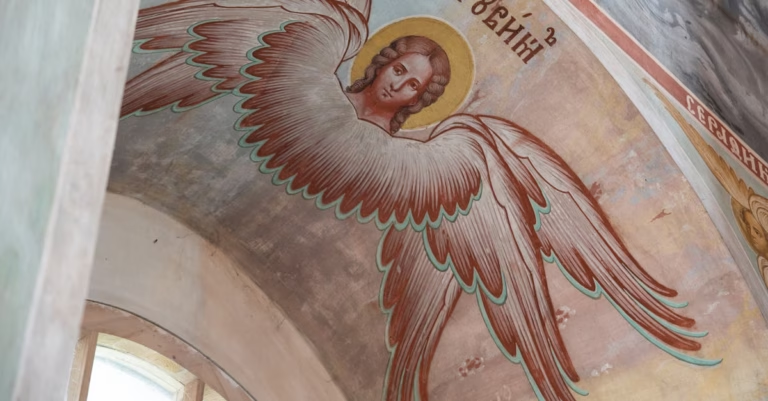
The profound request Ruth articulates to Boaz forms the very heart of this encounter, ushering her fully into **the sanctuary of intimacy**: “Spread the corner of your garment over your servant, for you are a kinsman-redeemer” (Ruth 3:9). This is not merely a plea for shelter or a romantic gesture; it is language steeped in covenant. The Hebrew word for “corner” or “garment” here is *kanaph*, which also means “wing.” This term carries a powerful resonance, echoing Boaz’s earlier blessing to Ruth in chapter 2, where he prayed that she would find refuge under the “wings” (kanaph) of the Lord, the God of Israel. Her request is, in essence, a direct appeal to Boaz to embody for her the redemptive protection of God, to extend his covenantal covering. It’s a bold claim, rooted in legal and theological understanding, yet articulated from a place of dependence. This action transcends mere legal formality; it becomes a deeply personal, relational act of trust and commitment.
The Church’s Enduring Claim: Praying Under the Wing

What does this mean for the Church today? It means that our most potent acts of “enforcing” our authority are not through political maneuvering or cultural dominance, but through reminding the King of His own promises. When we pray “in Jesus’ name,” we are engaging in a spiritual act akin to Ruth’s request. We are, in essence, asking Christ to “spread His garment over us”—to extend His *kanaph*, His protective wing, His covenantal covering. This is not a magic incantation, but a profound declaration of relationship and reliance. It is an act of love and deliverance that proclaims: “I am Yours, and You are my covering.” This covenantal language reveals that:
- **Our prayers are rooted in Christ’s identity, not our own merit.** We appeal to His nature as Redeemer, not our worthiness.
- **Our authority is derived, not inherent.** It flows from His name and His promises, which are ‘Yes’ and ‘Amen’ in Him.
- **Our protection is guaranteed by His faithfulness.** The “wing” of Christ is a symbol of His unwavering commitment to His people.
- **Our intimacy with God is secured by His covenant.** He has bound Himself to us through Christ, and we claim that bond.
This understanding transforms prayer from a mere request list into a powerful engagement with the living God, grounded in His irrevocable promises. It is a reminder that our security is not found in the strength of our own hands, but in the unwavering grasp of His.
Cultivating a Threshing Floor Mentality
The concept of the threshing floor, then, is not merely a historical agricultural practice; it is a profound spiritual metaphor for the environment where we cease our frantic efforts to impress the world and earnestly begin to seek the face of the Redeemer. It is the place where facades crumble and authentic identity is forged. In a world perpetually vying for our attention, demanding our performance, and offering superficial solutions, the Church is called to model something radically different: a life lived in humble dependence, sheltered under the protective *kanaph* of Christ. This requires intentionality, a deliberate turning away from the clamor and towards the quiet, where the most profound spiritual work often takes place. It means prioritizing seasons of “midnight silence” and adopting a “posture of humility,” recognizing that our greatest strength lies in our utter dependence on the One who redeems us. This isn’t about isolation, but about a reordering of priorities, ensuring that our public witness flows from a deep, hidden wellspring of communion.
We must cultivate this threshing floor mentality within our congregations and in our individual lives. It is the urgent task of this generation to recover the profound truth that our efficacy is not measured by earthly metrics, but by our unwavering commitment to Christ, our Redeemer. Let us therefore seek out those secret places, those moments of unadorned communion, where the world fades and the face of Christ becomes our sole focus. If you find yourself weary of the performance culture, or longing for a deeper connection beyond the superficial, consider embracing the quiet discipline of the threshing floor. Seek the face of the Redeemer, not the applause of the crowd, and discover the transformative power of genuine intimacy.
This journey into **the sanctuary of intimacy** is not an escape from reality, but an engagement with the most profound reality there is. Just as Ruth, vulnerable and exposed, found not judgment but covenantal love and redemption on the threshing floor, so too will we find our truest selves and our deepest purpose in those moments when we lay aside our defenses and simply rest in the shadow of His wing. The story of Ruth reminds us that the places of separation can become the very sites of our deepest encounter, the crucibles where true love is forged and lasting security is found.