The Church Is Born: Threshing Floor Faith & Covenant Wings
The Liturgical Audacity of the Outsider
The Book of Ruth is a masterclass in covenant theology, unfolding in the most unexpected of places and through the most unlikely of characters. Ruth, a Moabite, hailed from a people perpetually at odds with Israel, a nation whose very origins were marked by a scandalous incestuous relationship (Genesis 19:30-38). The Law explicitly forbade Moabites from entering the assembly of the Lord “even to the tenth generation” (Deuteronomy 23:3). She was, by all accounts, an absolute outsider, an alien, a widow with no prospects, no family, and no legal standing in Israelite society. Yet, it is this very outsider status that defines the audacious faith we are called to emulate.
Her approach to Boaz on the threshing floor, far from a clandestine romantic rendezvous, was a carefully orchestrated act, advised by her mother-in-law, Naomi, and steeped in ancient Israelite custom. She was not merely seeking a husband; she was seeking a redeemer, one who could restore her and Naomi’s inheritance, a kinsman-redeemer (go’el). This act underscores a fundamental truth about our faith: it is often in our most vulnerable, most exposed moments, stripped of all pretense and self-sufficiency, that we are truly positioned to receive God’s grace. The Church, in every age, finds itself in a world that often perceives it as an outsider, a peculiar people whose values and priorities are at odds with the prevailing culture. This is not a weakness to be overcome by assimilation, but a divinely appointed position from which to make a profound appeal to the true Master of the Harvest.
Spreading the Garment: A Covenantal Act, Not Romantic Intrigue

When Ruth asks Boaz to “spread the corner of your garment” (Hebrew: *kanaph*) over her (Ruth 3:9), she is not making a coy suggestion for intimacy. She is invoking a powerful biblical symbol of covenant protection and inclusion. This same imagery is found in Ezekiel 16:8, where God describes His covenant with Israel: “Later I passed by, and when I looked at you and saw that you were old enough for love, I spread the corner of my garment over you and covered your nakedness. I gave you my solemn oath and entered into a covenant with you, declares the Sovereign Lord, and you became mine.”
Consider what this request truly signified:
* **A plea for protection:** The *kanaph* (wing, corner of garment) symbolized shelter and security, much like a bird sheltering its young under its wings (Psalm 91:4).
* **A request for marital covenant:** To cover a woman with one’s garment was a recognized sign of taking her as a wife, entering into a marital bond.
* **An appeal for kinsman-redeemer duties:** Boaz, as a relative, had the right and obligation to “redeem” Naomi’s family land and to raise up an heir for her deceased son. Ruth was asking him to fulfill this sacred duty.
* **An act of profound trust:** Ruth placed herself entirely at Boaz’s mercy, trusting in his character and his adherence to God’s law.
This was a liturgical act, a public performance of faith and trust in the face of immense personal vulnerability. It was a request for Boaz to embody the covenant faithfulness of God himself. The Church, as the Bride of Christ, makes a similar request. We, too, are outsiders, once naked and exposed, now seeking the covering of the Redeemer’s *kanaph*.
Why The Church is Born on the Threshing Floor

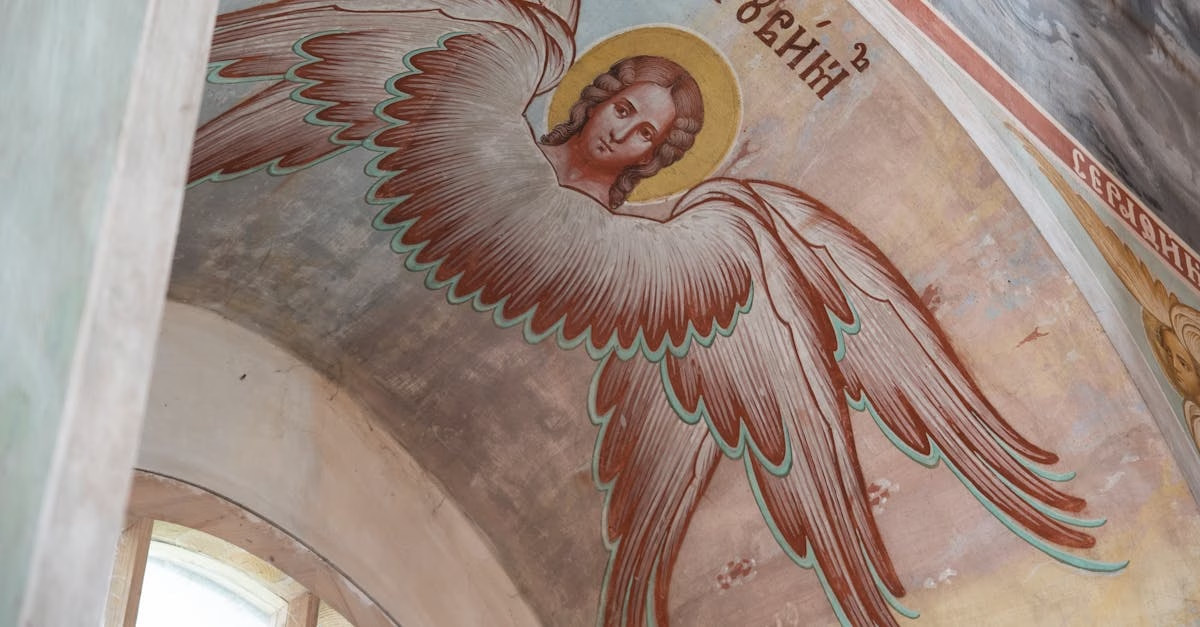
The setting of the threshing floor is itself symbolic. It is a place of separation, where grain is separated from chaff, where the valuable is distinguished from the worthless. It is a place of hard work, a place of harvest, and often, a place of nocturnal vigil. For **the Church is born on the threshing floor**, not in opulent cathedrals or centers of political power, but in places of humility and dependence. It is at the feet of the Redeemer, where the stranger is covered by the wings of the Covenant.
This imagery challenges our contemporary impulses to build influence through strength, to secure our future through strategic alliances, or to ensure our relevance through cultural accommodation. The Church’s true power and identity do not derive from these temporal metrics, but from her humble, audacious appeal to the sovereign grace of God. Just as Ruth, an outsider with no claim, found her place under Boaz’s garment, so too the Church, composed of those who were once “aliens from the commonwealth of Israel and strangers to the covenants of promise, having no hope and without God in the world” (Ephesians 2:12), finds her true home and inheritance under the vast wings of Christ’s redemptive covenant. Our birthright is not earned; it is received through a gracious covering.
Receiving the Redeemer’s Wings: Our Present Posture

In a world increasingly skeptical of institutions, and often hostile to Christian claims, the Church is frequently relegated to the margins—an outsider, a relic, an anomaly. This can be disorienting for those accustomed to cultural prominence. Yet, this very position, when embraced with theological clarity, can be our greatest strength. I’ve often observed how organizations, when feeling threatened, tend to double down on outward displays of power or internal mechanisms of control. The consistent testimony of history, however, reveals that the Church thrives not when it mimics the world’s strategies for dominance, but when it embodies the vulnerable, dependent faith of Ruth.
My own experience in grappling with the Church’s place in public life has consistently brought me back to this fundamental truth: our legitimacy does not come from winning cultural battles or wielding political might, but from faithfully bearing witness to the One who gathered us, the scattered and the undeserving, under His merciful wings. This means a posture of:
* **Humble Dependence:** Acknowledging our lack of inherent claim and relying entirely on God’s grace.
* **Audacious Prayer:** Daring to ask for God’s covenantal protection and provision, even when it seems illogical or impossible.
* **Prophetic Vulnerability:** Speaking truth to power, not from a position of worldly strength, but from the perceived weakness of the cross.
* **Faithful Witness:** Living out the implications of being covered by the Redeemer, extending grace and hospitality to other outsiders.
To paraphrase a similar sentiment I’ve shared, revival entails a change of affection. Sometimes that is seen in explosive growth, and at other times it is seen as a tiny remnant conserving what is true. In either case, it starts with knowing what it is: a divine gift, not a human achievement.
The Enduring Call to Audacious Faith
The story of Ruth and Boaz is not merely an ancient historical account; it is a timeless parable for the Church across all generations. It is a reminder that our identity, our security, and our future are not found in our own efforts, our own perceived strengths, or our own cultural currency. They are found in the audacious act of approaching the Master of the Harvest, a true kinsman-redeemer, and asking Him to spread the corner of His garment over us.
This is the enduring call to an audacious faith—a faith that recognizes its outsider status, its utter dependence, and yet dares to appeal to the boundless grace and covenant faithfulness of God. It is a faith that understands that true power is found in surrender, true security in vulnerability, and true belonging in being covered by the wings of the Redeemer.
Consider what it means for your own faith, your own community, to embrace this posture. How might the Church look different if we consistently remembered our origins on the threshing floor? If we are to be faithful to our calling, we must continue to approach the Master of the Harvest with Ruth’s same humility and daring, trusting that He will indeed spread His garment over us. Let us engage with this profound narrative and rediscover the radical truth of our inclusion.
Ultimately, **the Church is born on the threshing floor** not through human strategem or inherited privilege, but through audacious, covenantal dependence, finding her ultimate identity and protection under the expansive, gracious wings of the Redeemer. It is here, in this vulnerable act of faith, that the stranger becomes family, and the lost find an eternal home.