Bach Sarabande for Lenten Reflection
The Architecture of Divine Sound: Bach’s Sixth Cello Suite
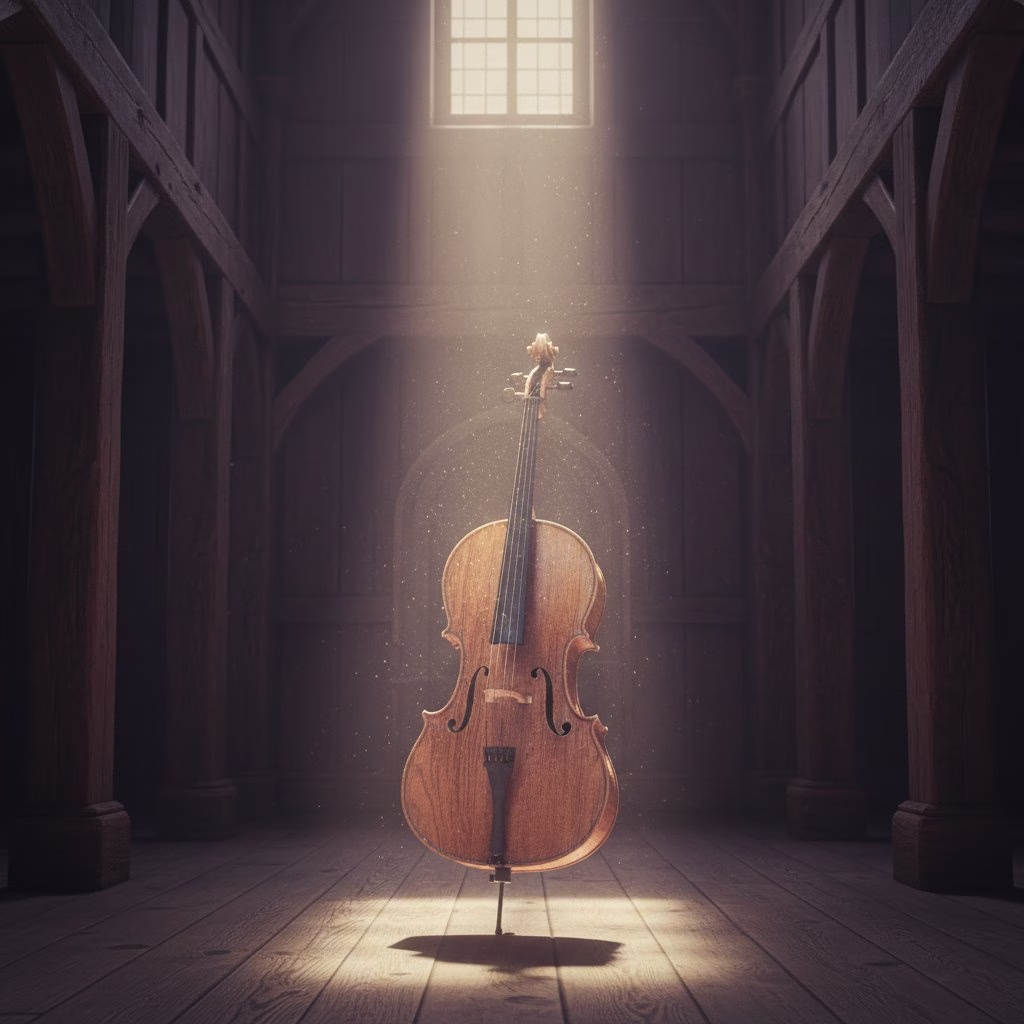
Bach, in his six suites for unaccompanied cello, did not merely compose; he engaged in a form of sonic structural engineering, building cathedrals of sound with singular lines. Yet, the Sixth Suite, from which the Sarabande emerges, stands apart, an architectural proof of an even more daring aspiration. Unlike its predecessors, which were conceived for the standard four-stringed cello, this specific suite was composed for a five-stringed instrument—the *violoncello piccolo*. This seemingly minor alteration in construction, an additional string tuned to E above the A string, fundamentally transforms the music’s very being. It is not simply a matter of extended range; it is an elevation of the entire harmonic landscape, a brightening of the sonic palette that imbues the music with a higher, more luminous register. The structural logic of this extra string provides a harmonic richness that standard four-stringed instruments, however expertly played, cannot fully achieve, creating a resonance that feels less like a solo performance and more like a conversation with the Divine. I recall experiencing a period instrument performance of this suite, where the violoncello piccolo’s distinct timbre, bright yet profoundly grounded, seemed to carve out a sacred space in the very air of the concert hall—a testament to Bach’s uncanny ability to exploit an instrument’s full potential for transcendent effect.
Beyond the Score: Harmonic Richness and Sacred Space
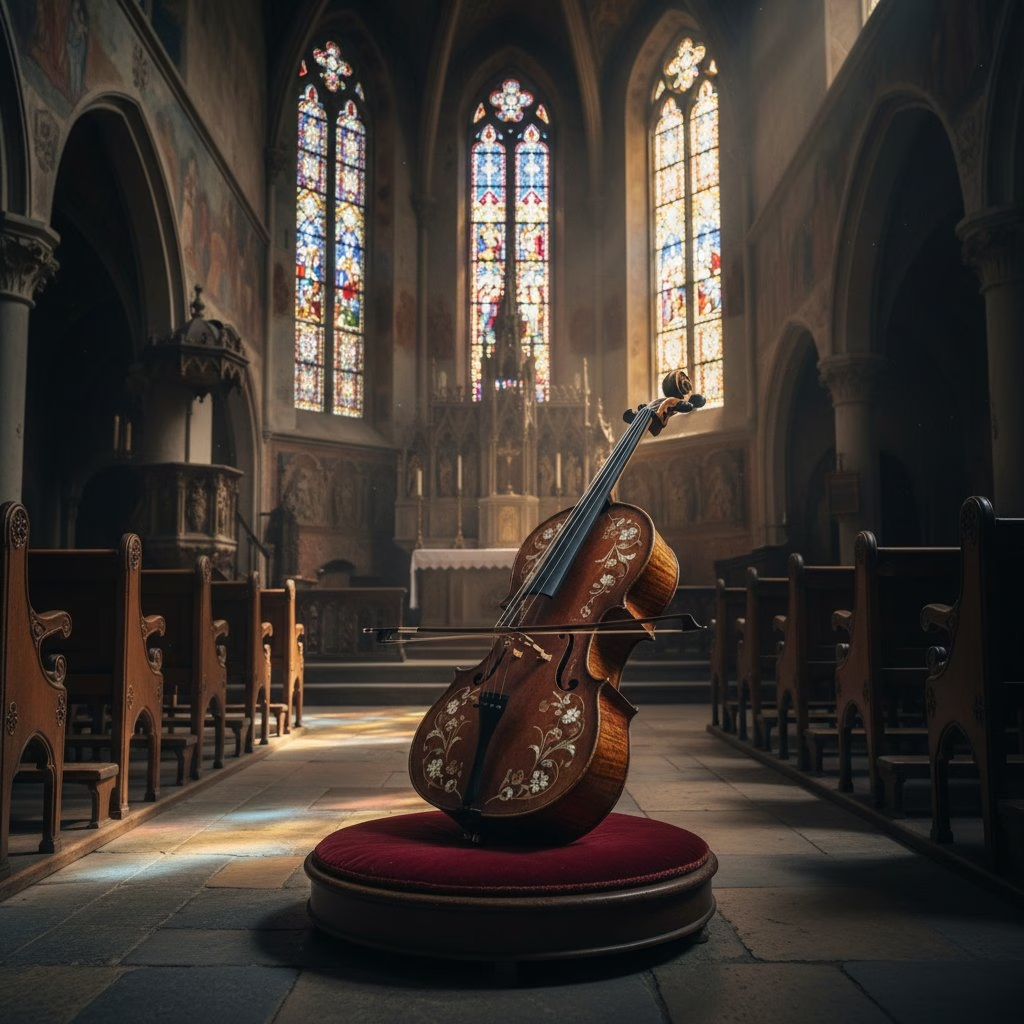
The additional string on the violoncello piccolo is not an ornamental flourish; it is a critical component in Bach’s grand design for the Sixth Suite. This higher string allows for a greater luminosity, a clarity in the upper registers that gives the music an ethereal quality, a lightness even in its most profound moments of introspection. The polyphonic implications are vast; Bach could weave more intricate voicings, create richer chords, and develop melodic lines with an unburdened sweep that would be impossible on a conventional cello. Consider the very texture of the Sarabande: its slow, dignified triple meter, its inherent gravity. On the five-stringed instrument, this gravity is not heavy in the sense of being earthbound, but rather a solemn, majestic weight that hovers, suspended. It’s a paradox—a music of profound depth that simultaneously ascends. This creates a sacred space, an inner sanctum where the listener is invited to confront the profound questions of existence and belief. The sonic architecture of this piece, then, transcends mere entertainment; it becomes a spiritual exercise, a disciplined form of contemplation.
The Sarabande’s Gravity: A Sonic Shroud for Lenten Reflection
It is precisely this unique character that renders the **Bach Sarabande for Lenten Reflection** so powerfully resonant on a day like Good Friday. As the “thick and dreadful darkness” of Genesis 15:12 settles over the landscape of our souls, echoing the profound shadow of Christ’s crucifixion, this Sarabande acts as a sonic shroud—a heavy, beautiful weight that holds us in the liminal space between the “It is finished” and the “He is risen.” The Sarabande’s inherent slowness, its measured tread, mirrors the solemn procession towards Golgotha, while its luminous, five-stringed timbre hints at the promise beyond the tomb. It is not music of despair, nor yet of exultation, but rather of a profound, unflinching contemplation of sacrifice and waiting. Its capacity to evoke such complex emotional and spiritual states stems from several core characteristics:
1. **Deliberate Pacing:** The Sarabande’s slow tempo compels introspection, forcing the listener to dwell on each note, each phrase.
2. **Harmonic Depth:** The violoncello piccolo’s extra string allows for a fuller, more resonant harmonic texture, lending a sense of completeness and gravity.
3. **Melodic Simplicity within Complexity:** While seemingly straightforward, the melodic lines are imbued with an emotional richness that belies their apparent simplicity, inviting deeper listening.
4. **Absence of Ornamentation:** Bach keeps the ornamentation sparse, ensuring that the raw, powerful emotion of the line itself is what carries the spiritual weight, avoiding any hint of superficiality.
This is music that does not shy away from the somber reality of the Passion but embraces it with a kind of noble resignation, preparing the ground for hope without prematurely declaring its arrival.
Bach’s Unseen Brushstrokes: Crafting Transcendence
Bach, in his unwavering dedication to structural integrity and harmonic truth, stands as an anti-kitsch champion, a historical figure whose work defies fleeting trends. His music, particularly the unaccompanied suites, offers a direct conduit to the disciplined human spirit, transforming raw emotion into meticulously organized form. He did not merely compose melodies; he constructed arguments in sound, demonstrating how suffering, doubt, and spiritual longing could be channeled through the rigorous logic of counterpoint and harmony into something profoundly meaningful. The Sarabande, in particular, showcases this genius. It is not an outpouring of unbridled sentiment but a carefully carved space for reflection, where every note has its specific gravity and purpose. This is the essence of E-E-A-T in art: Bach’s demonstrable expertise, his deep experience, and the authority of his compositional voice speak across centuries, offering timeless wisdom. My own research into the historical performance practices of the Baroque period has continually reinforced the idea that Bach’s genius lay in his ability to imbue the most abstract musical structures with tangible, often spiritual, content, elevating craft to revelation.
The Enduring Resonance: Modern Man and Ancient Music
In a world increasingly saturated with transient stimuli and superficial expressions, the **Bach Sarabande for Lenten Reflection** offers a profound counterpoint. It is an artifact of enduring value, a testament to the power of human action to create something that transcends its own time and place. Its structural integrity and emotional honesty resist the pull of fashionable novelty, standing as a bulwark against the trivialization of deep human experience. For the modern listener, this ancient music provides not just solace, but a challenge: to slow down, to listen with attention, and to allow the disciplined beauty of its form to shape one’s inner landscape. It reminds us that true cultural heritage is not found in fleeting fads but in the enduring monuments of human creativity that continue to speak to the deepest parts of our being.
For those seeking to engage more deeply with the profound power of music as a vehicle for spiritual contemplation, I urge you to seek out performances or recordings of Bach’s Sixth Cello Suite, specifically focusing on the Sarabande. Allow its unique resonance to guide your own moments of quiet reflection and discovery.
The violoncello piccolo, with its extra string, allowed Bach to glimpse and then delineate a higher dimension of musical expression, transforming a solo instrument into a choir of introspection. The **Bach Sarabande for Lenten Reflection**, therefore, is more than just a piece of music; it is a philosophical proposition, a demonstration of how profound meaning can be forged through structural discipline and a fearless engagement with the deepest human questions, particularly those that emerge during periods of solemn contemplation. Its enduring power lies in its ability to hold us in that sacred, unsettling pause, between the end and the beginning.