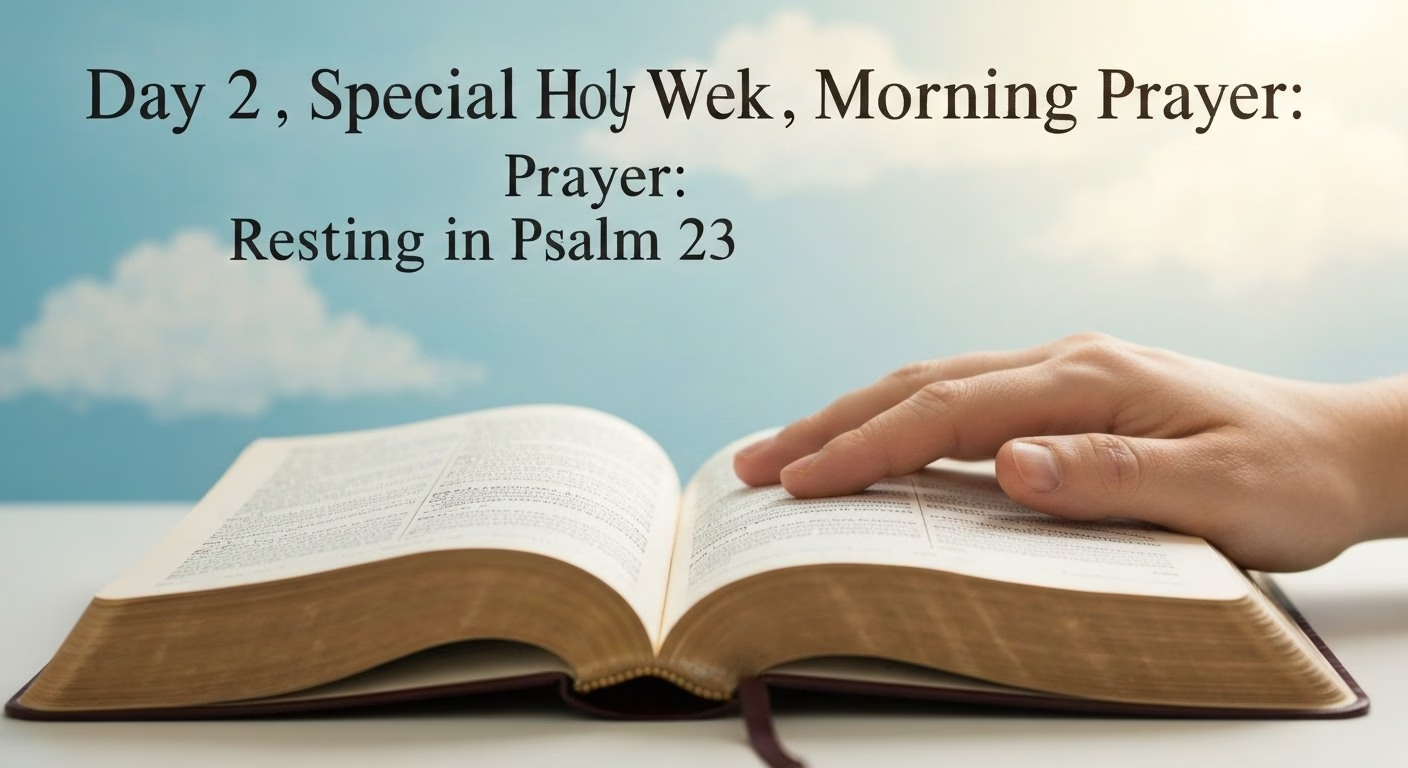
Special Holy Morning Prayer: The Scandal of the Green Pastures
Why is it that in an era defined by an almost pathological obsession with “wellness”—that manicured, secular liturgy of juice cleanses and expensive yoga retreats—we find ourselves more spiritually dehydrated than ever before? This Special Holy Morning Prayer session, held as we navigate the heavy shadows of Holy Week, invites us into a confrontation with a reality we often spend our lives trying to outrun: the necessity of the full stop. We are a people who have mistaken the noise of the machine for the breath of the Spirit, convinced that our worth is tied to the frantic motion of our hands rather than the state of our souls. We live in a culture that views “doing nothing” as a moral failure, yet the Psalmist suggests that it is, in fact, a divine mandate.
As we gathered for this Special Holy Morning Prayer on March 31, 2026, the focus shifted from the “paths of righteousness” we traversed yesterday to the stillness of the second verse of the twenty-third Psalm. “He makes me lie down in green pastures. He leads me beside quiet waters.” There is an offensive quality to that verb—”makes.” In our autonomous, Manhattan-centric world, we prefer to be the architects of our own itineraries. We want to choose our pastures. We want to schedule our resting periods as if they were line items on a quarterly budget. But the Good Shepherd does not offer a suggestion; He imposes a grace. He recognizes that, left to our own devices, we would graze until we collapsed or wander until we were lost.
The Theology of the Full Stop in Our Special Holy Morning Prayer
The danger of our current moment is that we have professionalized our spiritual lives to the point of exhaustion. We approach our faith with the same grim determination we bring to a boardroom meeting or a political campaign. We are looking for strategies, for metrics of success, for a way to “optimize” our devotion. But the Special Holy Morning Prayer of Day 2 reminds us that the primary movement of the spiritual life is not our activity toward God, but our reception of God’s activity toward us. The “green pastures” are not a reward for a job well done; they are the prerequisite for the work ahead.
Consider the contrast between this meditation and the previous day’s focus. Yesterday, we spoke of the “paths of righteousness”—the execution of the divine will, the purposeful stride toward the Kingdom. That is the active life. But today, the Shepherd insists on the contemplative life. He demands that we lie down. This is not merely a nap; it is a “full stop.” It is a recognition that the universe does not rest on our shoulders. When we lie down in the grass, our perspective changes. We no longer see the horizon we are trying to conquer; we see the sky that is already over us. We see the vastness of a Creator who was working long before we arrived and will be working long after we are gone.

In this Special Holy Morning Prayer, we must reckon with why this is so difficult for us. We resist the pastures because we fear that if we stop, we will be forgotten. We fear that the “hucksters and marks” of the world will pass us by. Yet, the irony of the Christian life is that our greatest productivity often emerges from our deepest stillness. The speaker noted that divine inspiration requires a “spiritual upgrade,” a transition from our own limited resources to the infinite glory of the Spirit. That upgrade does not happen while we are running; it happens while we are prone.
Quiet Waters and the Samaritan Woman’s Thirst
The “quiet waters” mentioned in our Special Holy Morning Prayer are not merely a scenic backdrop. They are a source of profound nourishment. In the biblical imagination, water is life, but it is also a mirror. Beside quiet waters, we are forced to look at ourselves—not the curated image we present on social media, but the actual reflection of our souls. This echoes the encounter between Jesus and the Samaritan woman at the well. She came for physical water, a repetitive chore that spoke of her daily survival. Jesus offered her “living water,” a source that would quench a thirst she hadn’t yet fully articulated.
Questions for Reflection
What does this article explain?
It explains the biblical meaning of Day 2 | Special Holy Week Morning Prayer: Resting in Psalm 23 and its significance for Christian faith today.
Why should Christians study the biblical feasts?
The feasts remember God’s salvation and presence, and Christians discern their fulfillment through Jesus Christ.