Sukkot Meaning for Christians: God’s Dwelling

The Ancient Echo: God’s Dwelling from Eden to Sinai
The entire biblical narrative, a grand epic of divine engagement, commences not with a thunderclap of cosmic distance, but with the gentle footsteps of the Creator walking with His creation in a garden, “in the cool of the day.” This primordial scene, fraught with both intimacy and eventual rupture, establishes a foundational truth: God’s desire has always been to dwell with humanity. This aspiration, though tragically interrupted by sin, was never abandoned. Instead, it was progressively revealed and symbolically enacted throughout Israel’s history.
From the idyllic garden, the drama shifts to the harsh, sun-baked wilderness, where the divine presence manifested in a portable desert tent—the Tabernacle. This was no majestic, immovable temple, but a humble, mobile sanctuary covered in ram skins dyed red and badger skins, designed to accompany a nomadic people. Yet, within its sacred confines, Moses conversed with God “face to face, as a man speaks with his friend.” The Hebrew *mishkan*, signifying dwelling, tent, or tabernacle, echoes through this period, reminding us that even in the midst of uncertainty and wandering, God’s presence was a tangible, if temporary, reality. The very construction of this tent, with its intricate details and precise instructions, underscored a theological principle: God was actively making space for Himself among His people, not as a distant potentate, but as an immanent companion on their arduous journey. This ancient pattern of divine indwelling, moving from a garden to a tent, laid the groundwork for an even grander, more permanent reality. It prefigured a dwelling that would transcend the limitations of both pristine paradise and portable sanctuary, pointing to a future where heaven and earth would permanently merge.
Sukkot Meaning for Christians: A Prophetic Rehearsal
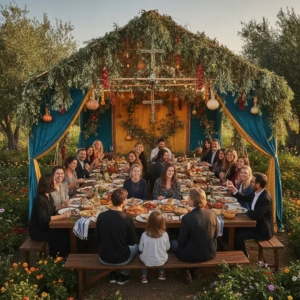
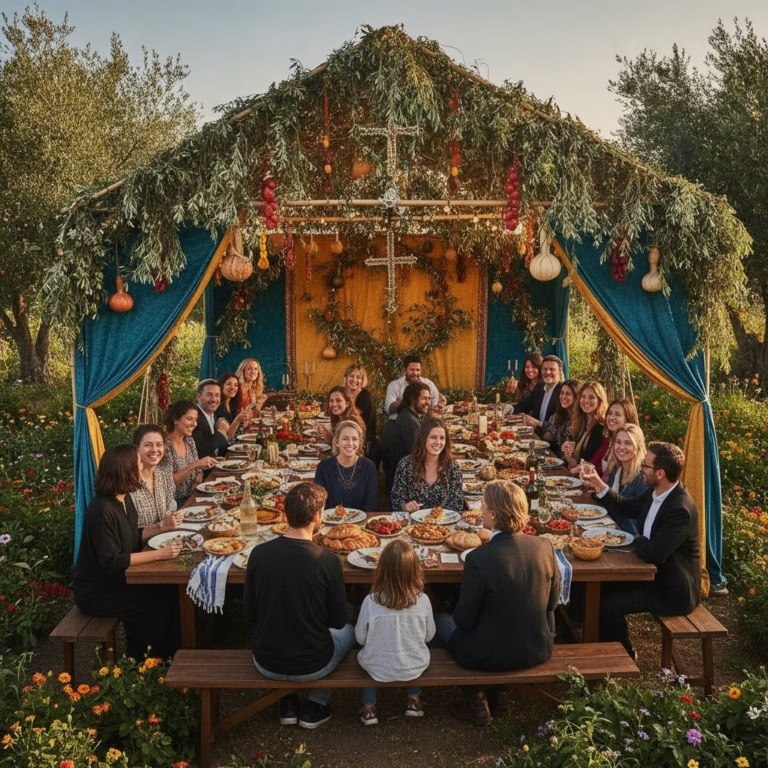
For Christians today, understanding the Sukkot meaning for Christians is to grasp a prophetic dress rehearsal for the new heavens and the new earth. The feast of Tabernacles, or Booths, required ancient Israelites to construct temporary dwellings—*sukkot*—and live in them for a week, commemorating their wilderness wanderings and God’s faithful provision. It was a tangible reminder of their transient state, their reliance on God, and the ultimate hope for a permanent home. This annual ritual, rich in historical memory, finds its ultimate fulfillment and profound resonance in the New Testament vision of God’s redemptive plan.
Consider the apocalyptic crescendo in Revelation 21:3–4: “And I heard a loud voice from the throne saying, ‘Now the dwelling of God is with men, and he will live with them. They will be his people, and God himself will be with them and be their God. He will wipe every tear from their eyes. There will be no more death or mourning or crying or pain, for the old order of things has passed away.'” The language here is not merely evocative; it is deeply rooted in the ancient understanding of God’s tabernacling presence. The Greek text precisely uses the Tabernacle root, *hē skēnē tou Theou meta tōn anthrōpōn* – “the tent of God is with humanity.” This isn’t an incidental linguistic choice; it’s a theological declaration that binds the wilderness tent to the eternal city. The fleeting *sukkah* thus becomes a powerful, tactile metaphor for the Christian hope. Every brittle branch and leafy roof, every night spent under the stars, whispers of a future where divine presence is no longer mediated by ritual or confined to a structure, but is a complete, unhindered communion. It reminds us that our faith is not about escaping this physical world for some disembodied abstraction, but about the redemption and ultimate remaking of creation, where God’s presence permeates all reality.
The Transient and the Permanent: Living in the ‘Already, Not Yet’
The profound Sukkot meaning for Christians helps us navigate the inherent tension of living in the “already, not yet”—the reality that Christ has inaugurated His kingdom, but its full consummation awaits. Our current existence is marked by a series of impermanent shelters, experiences that remind us of the fragility and provisional nature of this fallen world.
Consider the pervasive human condition:
- Sickness and Frailty: Our bodies, though fearfully and wonderfully made, are subject to decay, disease, and the inevitable march of time. They are temporary dwellings for our souls.
- Bereavement and Loss: The sting of death reminds us that our most cherished relationships, while eternal in spirit, are experienced in temporary earthly forms, leaving us with profound grief.
- Relational Friction and Brokenness: Even in our closest bonds, we encounter conflict, misunderstanding, and the pain of unmet expectations, revealing the provisional nature of human perfection.
- Systemic Injustice and Disorder: The pervasive brokenness of our social, economic, and political structures speaks to a world that is not as it should be, where justice is often delayed or denied, and peace remains elusive.
These tribulations are not our ultimate reality; they are the temporary shelters through which we pass on our pilgrimage. The prophetic vision of Revelation 21:4—”He will wipe every tear from their eyes. There will be no more death or mourning or crying or pain, for the old order of things has passed away”—offers a radical counter-narrative to our present sorrows. Sukkot, in its annual reenactment of impermanence, paradoxically grounds our hearts in the settled hope of something permanent. It teaches us to hold lightly to the present sufferings, knowing that they are but transient scenes in the grand drama of redemption.
Beyond Escapism: The Earth Redeemed

A common misconception, often found lurking within certain strains of Christian thought, suggests that the ultimate goal of faith is an ethereal escape from this earthly realm, a disembodied ascent to a distant heaven. This perspective often diminishes the significance of creation and the tangible realities of human experience. However, the Sukkot meaning for Christians fundamentally challenges this escapist narrative. The biblical vision, from the opening chapters of Genesis to the closing verses of Revelation, consistently emphasizes God’s commitment to His creation. The redemption plan of God has never been solely about snatching individual souls from a doomed planet; it has always been about the renewal and restoration of *all things*.
When Revelation speaks of a “new heaven and a new earth,” it is not positing the annihilation of the old and its replacement with something entirely alien. Rather, it speaks to a profound transformation, a purification and perfection of what God originally declared “very good.” The ultimate dwelling place is not a celestial cloud, but a city—a New Jerusalem—descending from heaven to earth. This is the culmination of God’s desire to dwell, to *tabernacle*, permanently with His people *on a renewed earth*. This merging of heaven and earth implies a continuity, a sanctification of the physical and material, elevating them beyond their present brokenness. The sukkah, in its materiality, its reliance on natural elements—branches, leaves, the open sky—serves as a tangible reminder that our hope is rooted not in a rejection of creation, but in its glorious redemption. It anchors our hearts in the tangible, reminding us that God’s love extends to the dust from which we came and the earth to which we are bound.
Pitching Our Hearts: Cultivating an Eternal Perspective
As we reflect on the profound Sukkot meaning for Christians, we are invited to a radical reorientation of our lives. It is an invitation to step out of the frantic exhaustion that so often accompanies self-reliance—the relentless striving to build our own permanent shelters in a world that offers none. This ancient feast, with its echoes of divine provision in the wilderness, calls us to embrace a different rhythm, a different posture before God.
To pitch our hearts in the unhurried presence of the Father means to intentionally cultivate a reliance on His grace, acknowledging that our security and hope do not derive from our own strength or ingenuity. It is to drink deeply from the river of the Holy Spirit, allowing His life-giving presence to refresh our parched souls and provide the strength for our journey. This spiritual posture enables us to rejoice with unshakeable peace, knowing that the God who faithfully guided Israel through the desert, who provided manna and water from the rock, holds our coming year—indeed, our entire future—firmly in His hands. This is not a passive resignation, but an active trust, a profound confidence in the God who makes His dwelling among us, both now and eternally.
For those eager to delve deeper into these rich biblical themes and discover how the ancient feasts continue to illuminate our Christian faith, consider exploring the broader tapestry of God’s redemptive story. Engaging with these historical and prophetic connections can deepen your understanding and appreciation for the continuity of God’s plan across testaments.
The Sukkot meaning for Christians ultimately culminates in a settled hope, a vision of the ultimate dwelling where every tear is wiped away, and death, mourning, crying, and pain are no more. It is a powerful reminder that our temporary earthly sojourns, marked by sickness, bereavement, relational friction, and systemic injustice, are not the final word. The God who began His relationship with humanity walking in a garden, who faithfully tabernacled with His people in a wilderness tent, is the same God who will ultimately make His permanent dwelling with us in a renewed creation. This is the promise that holds our hearts firm, even when the world around us feels like nothing more than a collection of fleeting, fragile booths.
Questions for Reflection
What does this article explain?
It explains the biblical meaning of Sukkot Meaning for Christians: God’s Dwelling and its significance for Christian faith today.
Why should Christians study the biblical feasts?
The feasts remember God’s salvation and presence, and Christians discern their fulfillment through Jesus Christ.