The Science of the Theta State and the Architecture of the Soul
Did you know that from birth to age seven, your child’s brain is literally a sponge for the Divine, and that understanding the science of the theta state reveals why our modern, rationalistic approach to spiritual formation is often tragically late? We tend to view the early years of a child’s life as a sort of waiting room for the intellect—a period of diapers and babbling that must be endured before the real work of catechesis can begin. We wait for the age of reason, for the moment the child can articulate a coherent soteriology or at least sit still through a sermon. But while we are waiting for the “rational” mind to wake up, the subconscious mind is already hard at work building the foundation of the house. The neurobiological reality is that the most profound spiritual “grafting” happens long before a child can explain the mechanics of grace.
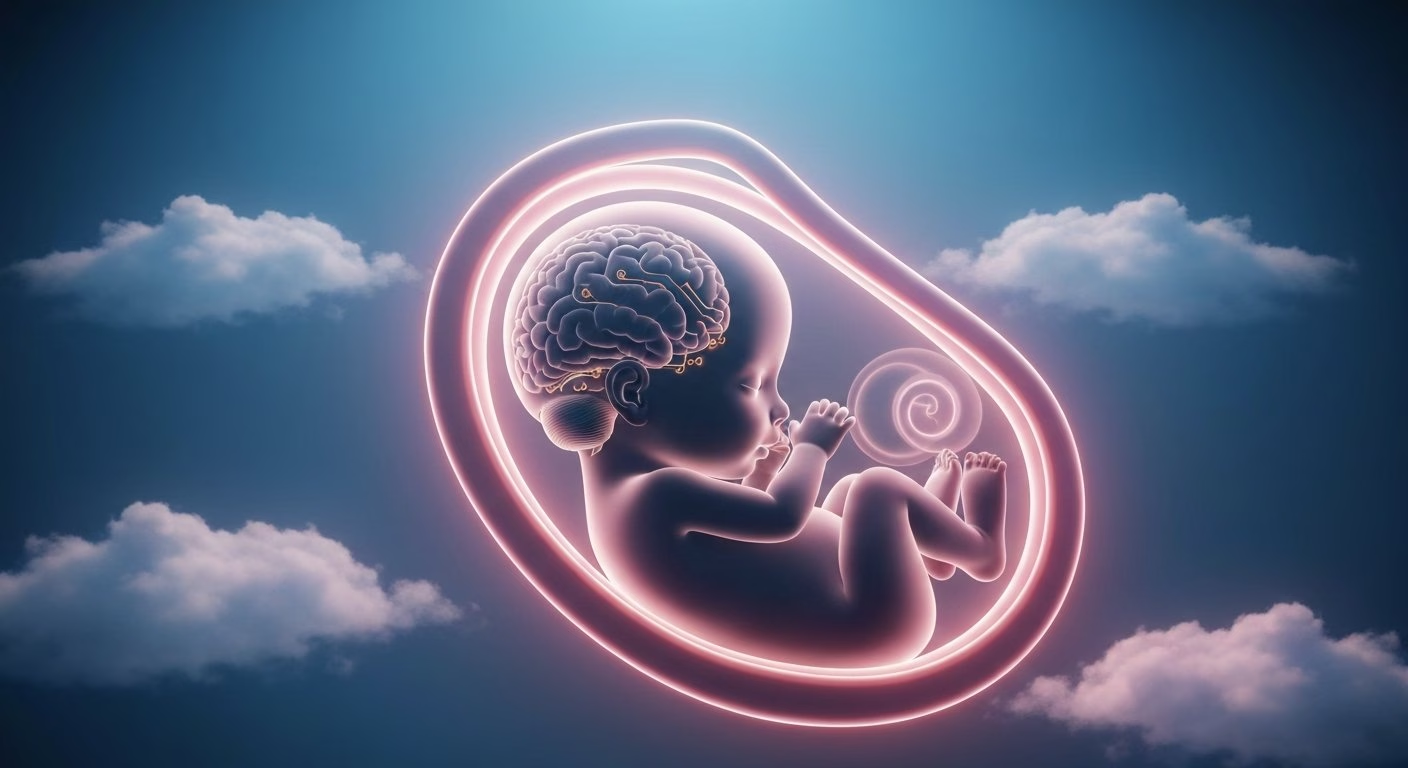
In the high-speed, information-saturated corridors of Manhattan, we often prize the cognitive over the contemplative. We want our children to be “smart,” to be competitive, to be articulate. Yet, the the science of the theta state suggests that the most critical period of human development isn’t about the accumulation of facts, but the formation of a fundamental orientation toward the world. Between the ages of zero and seven, a child’s brain operates primarily in the Theta frequency—a state of deep suggestibility, imagination, and “super-learning.” This is the same state that, in adults, is reached only through deep meditation or the moments just before sleep. For a child, this is their baseline reality. They are not just learning about the world; they are absorbing it into their very nervous system.
[INTERNAL_LINK: liturgical formation]
Harnessing the Science of the Theta State for Spiritual Vitality
When we talk about the science of the theta state, we are talking about a window of time where the “critical filter” of the conscious mind has not yet been fully constructed. This is why a five-year-old can move seamlessly between a game of make-believe and a conversation about the Creator. To them, the veil between the seen and the unseen is not thin; it is non-existent. This is not a deficiency to be cured by “growing up,” but a biological gift to be honored by the Church. If the brain is in a state of constant download, we must ask ourselves what software we are installing. Are we installing the frantic, fragmented rhythms of secular consumerism, or the slow, deep cadences of the Gospel?
The implications for our sacramental life are staggering. When we bring an infant to the baptismal font, or when we allow a toddler to smell the incense and hear the chanting of the Psalms, we are not just performing “nice” ceremonies for the sake of the grandparents. We are engaging with the brain’s peak developmental window. The liturgy is not an intellectual exercise; it is a sensory immersion. For a child in the Theta state, the water of baptism and the bread of the Eucharist are not “symbols” in the modern, evacuated sense of the word. They are foundational realities that are being woven into the neural pathways of their developing mind. We are building the internal hardware that will one day support the software of their adult faith.
Consider the way a child learns their native tongue. They do not begin with a grammar textbook or a list of irregular verbs. They are immersed in the sound of it; they absorb the cadence, the inflection, and the rhythm long before they understand the syntax. Spiritual formation should be no different. The “language” of faith—the prayers, the gestures, the stories—must be whispered into the Theta state so that by the time the child reaches the “age of reason,” the Gospel feels as natural and as necessary as the air they breathe. We are not just teaching them about God; we are teaching them how to perceive God.
Beyond the Rationalist Trap: Why Early Formation Matters
Our modern crisis of faith is, in many ways, a crisis of the imagination. We have treated Christianity as a set of propositions to be debated rather than a reality to be inhabited. By the time we start “teaching” children about the faith in a formal, classroom setting, the window of the Theta state is often closing. We are trying to convince the conscious mind of something that the subconscious mind has already decided is irrelevant. If the first seven years are spent in a secular vacuum, the child’s “internal hardware” will be calibrated to a world without transcendence. It becomes an uphill battle of apologetics rather than a natural flowering of an early-planted seed.
Why Do I Keep Having Nightmares? Find Spiritual Peace
Why Do I Keep Having Nightmares? Find Spiritual Peace When we ask ourselves, why do I keep having nightmares?, we often search for answers in
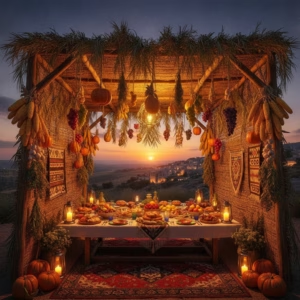
Sukkot Meaning for Christians: God’s Dwelling
Sukkot Meaning for Christians: God’s Dwelling In a world often defined by digital ephemera and the transient nature of our online presences, the Sukkot meaning
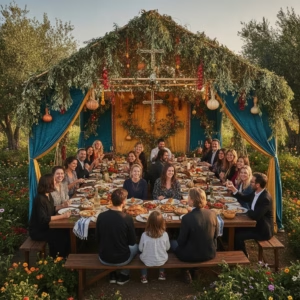
How Christians Celebrate Sukkot Today: A Modern Look
How Christians Celebrate Sukkot Today: A Modern Look In a world often defined by the fleeting and the ephemeral, **how Christians celebrate Sukkot today** offers
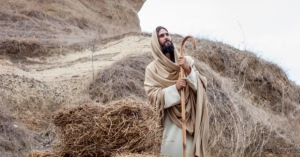
How Jesus Celebrated the Feast of Tabernacles
How Jesus Celebrated the Feast of Tabernacles How Jesus Celebrated the Feast of Tabernacles (Sukkot) offers a profound lens through which to consider our own
The Church Is Born: Threshing Floor Faith & Covenant Wings
The Church Is Born: Threshing Floor Faith & Covenant Wings Imagine the sheer audacity of standing before a powerful figure, a landowner, a master

Security Before the Settlement: Profound Promise Between Ruth and Boaz
Security Before the Settlement: Profound Promise Between Ruth and Boaz How often do we find ourselves anxiously awaiting the final gavel, the signed document,