Why the Firstborn of Israel Are God’s: A Deep Dive into Exodus and Divine Claim
The concept of the “firstborn” holds profound significance in the ancient world, often denoting special status, inheritance, and a unique position within a family or society. In the narrative of the Hebrew Bible, particularly around the pivotal event of the Exodus, this concept takes on an even deeper, divine dimension. God not only claims the firstborn of Israel as His own but establishes this claim through acts of unparalleled power, justice, and mercy. Understanding why the First Born of Israel are God’s unravels layers of theological truth about His sovereignty, redemption, and the very foundation of His covenant with His chosen people.
The Divine Claim Over the Firstborn of Israel
Understanding the Significance of the Firstborn in Ancient Israelite Society
In the ancient Near East, the firstborn son held a preeminent position. He was typically the heir apparent, destined to receive a double portion of the inheritance, assume leadership of the family, and carry on the family name and legacy. This position was not merely one of privilege but also of responsibility, embodying the family’s future. To be the firstborn was to be uniquely set apart, a symbol of the family’s strength, continuity, and blessing. This cultural backdrop is essential for grasping the weight of God’s claim – He was not just taking an ordinary member of the family, but the one who represented the very essence and future of Israelite society. The firstborn was seen as the “firstfruits” of the womb, the initial and often most robust blessing bestowed upon a family, and thus, held a sacred quality even before divine intervention. This societal understanding elevates the divine claim from a mere directive to a profound statement about ownership and priority.
God’s Initial Declaration: Israel as His “Firstborn Son” Before the Exodus
Long before the dramatic events of the tenth plague, God made an astonishing declaration to Pharaoh through Moses: “Thus says the Lord, Israel is My firstborn son” (Exodus 4:22). This statement is foundational to understanding the subsequent events and God’s claim over the individual firstborn. By calling the entire nation of Israel His “firstborn son,” God was asserting a unique, covenantal relationship with them. It signified that Israel held a special place in His heart and plan among all the nations of the earth. Just as an earthly firstborn was heir to their father’s blessings and responsibilities, so too was Israel designated to be the recipient of God’s blessings and the carrier of His divine purpose to the world. This declaration was not merely a metaphor; it was a profound theological truth establishing Israel’s unique identity and relationship with the Almighty. It also served as a warning to Pharaoh: to harm Israel was to harm God’s own firstborn, inviting divine retribution. This initial claim sets the stage, demonstrating that God had a prior, inherent right to Israel, establishing a divine paternity that underpinned all future actions.
The Exodus Event: The Foundational Act of Divine Ownership
Pharaoh’s Stubbornness and the Escalation of God’s Judgments
The narrative of the Exodus is a testament to God’s power and justice, unfolding through a series of increasingly severe plagues. Pharaoh, the ruler of the mighty Egyptian empire, repeatedly defied God’s command to “Let My people go” (Exodus 5:1). His stubbornness and hardened heart led to an escalation of divine judgments, each plague demonstrating God’s dominion over nature and the gods of Egypt. From water turning to blood, to swarms of frogs, gnats, and flies, to livestock disease, boils, hail, locusts, and darkness, each plague served as a warning and an opportunity for Pharaoh to relent. Yet, with each act of defiance, Pharaoh sealed his own fate and the fate of his nation. This escalating conflict was not merely a display of power, but a purposeful demonstration of God’s unwavering commitment to redeem His firstborn nation, Israel, from bondage, even at great cost to their oppressors. The stage was being meticulously set for the ultimate, most devastating judgment.
The Tenth Plague: The Striking Down of Egypt’s Firstborn
The climax of God’s judgments against Egypt came with the tenth and final plague: the death of the firstborn throughout the land of Egypt. This was not a random act but a direct, terrifying consequence of Pharaoh’s refusal to release God’s “firstborn son,” Israel. As God Himself declared, “About midnight I will go out into the midst of Egypt, and all the firstborn in the land of Egypt shall die, from the firstborn of Pharaoh who sits on his throne, even to the firstborn of the slave girl who is behind the handmill, and all the firstborn of the cattle” (Exodus 11:4-5). This plague was unique in its devastating scope and its specific targeting of the most cherished and significant members of every Egyptian household. It struck at the very heart of Egyptian succession, vitality, and religious beliefs, as even Pharaoh himself was considered a divine firstborn. The cry that arose from Egypt was unprecedented, a universal lament that finally broke Pharaoh’s will and compelled him to release the Israelites. This act was a profound demonstration of God’s ultimate sovereignty over life and death, and His unwavering commitment to His covenant.
God’s Deliverance and Protection of Israel’s Firstborn During the Exodus
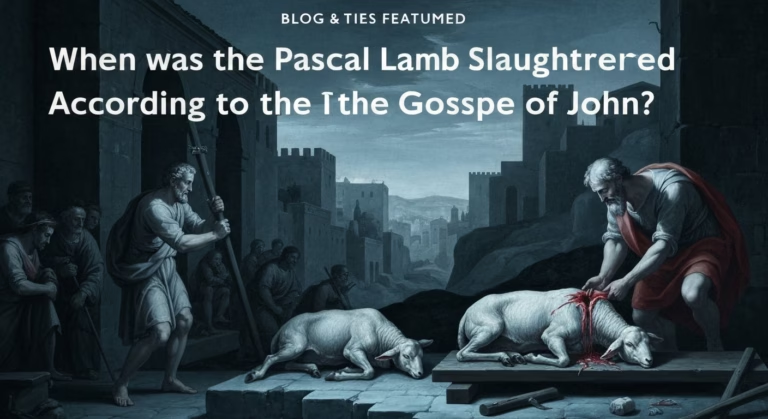
In stark contrast to the judgment meted out upon Egypt, God provided a clear means of deliverance and protection for Israel’s firstborn. This act of salvation is known as the Passover. God commanded each Israelite family to select an unblemished lamb, sacrifice it, and apply its blood to the doorposts and lintel of their homes. “When I see the blood, I will pass over you, and no plague will befall you to destroy you, when I strike the land of Egypt” (Exodus 12:13). While the angel of death swept through Egypt, bringing judgment, it “passed over” the homes marked with the blood, preserving the lives of Israel’s firstborn. This miraculous distinction underscored God’s faithfulness to His people and solidified His claim over them. Their deliverance was not by their own merit or strength, but solely by God’s grace and the sacrificial blood. This act of preservation, amidst the widespread devastation, was the foundational moment that cemented God’s ownership of Israel’s firstborn, establishing a debt of life and a perpetual reminder of their redemption.
The Consecration Command: God’s Mandate for the Firstborn
The Immediate Aftermath of the Exodus: God’s Instruction to Moses
Immediately following the harrowing night of the tenth plague and the dramatic departure from Egypt, God issued a direct and unambiguous command to Moses. The experience of divine judgment and miraculous deliverance was to be forever etched into the fabric of Israelite life through a specific ritual. “Consecrate to Me all the firstborn. Whatever is the first to open the womb among the people of Israel, both of man and of beast, is Mine” (Exodus 13:1-2). This instruction was not a suggestion but a divine mandate, an immediate response to the pivotal events that had just unfolded. The command came at the very moment of their newfound freedom, emphasizing that their liberation was intrinsically linked to God’s claim over their firstborn. It was a declaration of ownership, a tangible representation of the cost of their freedom and the depth of God’s intervention.
“Sanctify to Me All the Firstborn”: A Perpetual Memorial of Redemption
The command to “sanctify” or “consecrate” means to set apart as holy, to dedicate exclusively to God. By claiming all the firstborn, God established a perpetual memorial of Israel’s redemption from slavery. Every firstborn child and animal born in Israel would serve as a living, breathing reminder of that terrifying night in Egypt when God’s power saved them and struck down their oppressors. This wasn’t merely a historical commemoration; it was a continuous theological statement. It meant that life itself, particularly the “firstfruits” of life, belonged to God because He had preserved it. This act of consecration was a constant, tangible link between the present generation and the foundational act of deliverance, ensuring that the story of the Exodus and God’s faithfulness would never be forgotten within the Israelite community. It imprinted the truth of divine ownership onto the very structure of their society.
The Link Between the Passover and the Consecration of the Firstborn
The connection between the Passover and the consecration of the firstborn is undeniable and profound. The Passover event, marked by the blood on the doorposts, was the act of divine deliverance that spared Israel’s firstborn from death. Because God had “passed over” them, preserving their lives when He took the lives of Egypt’s firstborn, He established a unique claim. Their lives were, in a sense, “bought” by God’s intervention. Therefore, the consecration of the firstborn was the logical and necessary consequence of the Passover. It was the divine acknowledgment of this purchased life. The command to consecrate them came immediately after the Passover, emphasizing that the act of salvation directly resulted in an act of divine ownership. The Passover established their redemption; the consecration confirmed their status as God’s own. One event was the cause, the other the effect and the perpetual reminder of that cause.
Theological Significance of God’s Claim on the Firstborn
A Symbol of God’s Sovereign Power and Justice
God’s claim on the firstborn of Israel, rooted in the Exodus, is a powerful symbol of His absolute sovereign power and unwavering justice. By striking down the firstborn of Egypt while preserving Israel’s, God demonstrated His ultimate authority over life and death. He is the Creator and Sustainer of all, and therefore, holds the prerogative to give and to take life. This act was a profound exercise of justice against a nation that had enslaved and oppressed His chosen people for centuries, even attempting to annihilate their male firstborn (Exodus 1:16). The tenth plague was a divine “eye for an eye” on a national scale, a righteous retribution for Egypt’s cruelty and Pharaoh’s defiance. It underscored that no earthly power, no human king, could stand against the will of the Almighty. This dramatic display solidified God’s position as the supreme sovereign, whose decrees are absolute and whose justice is undeniable.
Emphasizing God’s Ownership of All Life and Creation
While specifically claiming the firstborn, God’s actions during the Exodus and the subsequent command to consecrate them serve to emphasize a broader theological truth: God’s ownership of all life and all creation. In ancient thought, the firstfruits or the firstborn often represented the whole. By claiming the most significant part – the firstborn – God effectively declared His ownership over all of Israel, and by extension, over all humanity and the entire created order. The preservation of Israel’s firstborn and their subsequent dedication to God was a microcosm of His universal dominion. It taught Israel, and through them, the world, that every breath, every life, and every blessing ultimately originates from and belongs to the Creator. This principle extends beyond human life to animals and the produce of the land (firstfruits), reinforcing that everything good comes from God and is ultimately His. It is a foundational truth that calls for reverence, gratitude, and submission to His divine will.
The Covenantal Basis for Israel’s Status as God’s Chosen People
The Exodus event and God’s claim on the firstborn formed the very bedrock of Israel’s covenantal relationship with God. When God declared Israel His “firstborn son” (Exodus 4:22), He established a unique, familial bond. The subsequent redemption from Egypt, sealed by the blood of the Passover lamb and the consecration of the firstborn, transformed this declaration into a lived reality. Israel became God’s chosen people, not through their own merit, but through God’s sovereign act of redemption and His subsequent claim. This act of divine ownership formed the basis of their covenant. As God’s “firstborn,” Israel was called to a special relationship of obedience, service, and witness to the nations. Their unique status was not merely a privilege but a responsibility, a constant reminder of the price of their freedom and the depth of God’s love and commitment to them. The firstborn claim solidified their identity as a people set apart, bound to God by an unbreakable covenant.
The Practical Implementation: Redemption and Substitution
The Requirement to Redeem Human Firstborn Sons
While God claimed all firstborn sons, He did not require their literal sacrifice. Instead, He instituted a system of redemption. “Every firstborn of man among your sons you shall redeem” (Exodus 34:20). This meant that the firstborn son, though belonging to God, could be bought back from direct service or sacrifice through a redemption price. Numbers 18:15-16 specifies this price as five shekels of silver, from a month old and upward. This redemption was not a negation of God’s ownership but an acknowledgment of it, allowing the family to retain their son while still honoring God’s claim. It served as a constant reminder that their lives were ultimately God’s and had been spared through His grace during the Exodus. The act of redemption highlighted the sanctity of human life and God’s provision for His people, demonstrating that while He claimed them, He also provided a means for their continued life and integration into the community.
The Role of the Levites as a Substitute for the Firstborn of Israel
God further elaborated on the practical implementation of His claim by instituting a substitutionary system involving the tribe of Levi. “Behold, I have taken the Levites from among the people of Israel instead of every firstborn who opens the womb among the people of Israel. The Levites shall be Mine” (Numbers 3:12). God chose the entire tribe of Levi to serve Him in the Tabernacle and later the Temple, fulfilling the service that would have otherwise fallen to the redeemed firstborn sons from all tribes. This was a direct exchange: the Levites were dedicated to God for sacred service in place of the firstborn. A census was taken of both the firstborn males of Israel and the Levite males, and a precise numerical equivalency was established. For any firstborn males who exceeded the number of Levites, an additional redemption price was paid (Numbers 3:46-51). This substitution underscored the seriousness of God’s claim while providing a practical and centralized way for His people to fulfill their obligation, allowing the Levites to dedicate their lives entirely to sacred duties.
The Offering of Firstborn Animals and Firstfruits as Sacred to God
The principle of consecration extended beyond human firstborns to animals and agricultural produce. “Every firstborn of a donkey you shall redeem with a lamb, but if you do not redeem it, then you shall break its neck. Every firstborn of man among your sons you shall redeem. And every firstborn of your cattle you shall consecrate to the Lord” (Exodus 13:13). Clean firstborn animals (like cattle and sheep) were to be sacrificed to God, acknowledging His ownership and providing sustenance for the priests. Unclean animals (like donkeys) were to be redeemed with a lamb or put to death, preventing their common use and reiterating the principle of divine claim. Similarly, the “firstfruits” of the harvest—the initial and best produce of the land—were also declared sacred to God and were to be offered to Him (Exodus 23:19; Deuteronomy 26:1-11). This comprehensive system ensured that the principle of God’s ownership of the “first” and “best” was woven into every aspect of Israelite life, from family to farm, serving as a constant, tangible reminder of His providential care and their covenantal obligations.
Enduring Legacy and Broader Theological Implications
Reflecting on the Themes of Redemption and Deliverance
The narrative of God’s claim on the firstborn of Israel is fundamentally a story of profound redemption and deliverance. It reminds us that humanity, in its fallen state, is enslaved to sin and death, much like Israel was enslaved in Egypt. Just as God intervened with mighty acts to deliver His “firstborn son” Israel, so too does He offer deliverance from spiritual bondage. The Passover lamb, whose blood provided salvation, foreshadows the ultimate Lamb of God, Jesus Christ, whose sacrificial death redeems humanity from the power of sin and death. The preservation of Israel’s firstborn through the blood on the doorposts points to the New Covenant where believers are delivered through the shed blood of Christ. This foundational story teaches us about God’s active involvement in human history, His compassion for the oppressed, and His sovereign power to save those He chooses. It calls us to reflect on the cost of our own redemption and the immense grace extended to us.
The Firstborn as a Precedent for Future Sacrifices and Offerings
The consecration of the firstborn established a powerful precedent for the entire sacrificial system that God instituted through Moses. The idea of setting apart the “first” and the “best” for God permeated Israelite worship and practice. From the daily burnt offerings to specific sin and peace offerings, the principle of giving God what is rightfully His, and what is most precious, was central. The firstborn concept laid the groundwork for understanding the nature of sacrifice—that it is an act of acknowledging God’s ownership, expressing gratitude, and seeking atonement. Ultimately, this precedent culminates in the person of Jesus Christ, who is described as the “firstborn over all creation” (Colossians 1:15) and the “firstborn from the dead” (Colossians 1:18; Revelation 1:5). He is the ultimate firstborn, given by God as the perfect sacrifice, fulfilling all the types and shadows of the Old Testament system. His life, death, and resurrection represent the ultimate offering, fully consecrating humanity back to God.
Lessons from the Exodus for Faith, Obedience, and God’s Faithfulness
The story of why the firstborn of Israel are God’s is rich with enduring lessons for believers today. It teaches us about the critical importance of faith in God’s word and His promises, even when circumstances seem impossible. Israel’s deliverance required their obedience to the Passover instructions, a reminder that faith often necessitates action. It highlights God’s unwavering faithfulness to His covenant, demonstrating that He remembers His promises and will act decisively to fulfill them, even against the greatest opposition. The narrative also underscores the call to obedience for God’s people, recognizing that our lives, like the firstborn of Israel, are not our own but belong to Him who redeemed us. This understanding should inspire a life of dedication, gratitude, and service, knowing that we are part of a larger divine plan. The Exodus, with its profound lessons about the firstborn, continues to be a cornerstone of faith, calling us to trust, obey, and marvel at the boundless faithfulness of our God.
Ready to explore more of God’s ancient truths and their powerful relevance for today? Dive deeper into the rich tapestry of Scripture with our insightful resources and discover the timeless wisdom within His Word.
Frequently Asked Questions
Why did God claim the firstborn of Israel as His own?
God claimed the firstborn of Israel as His own primarily due to the pivotal Exodus event, specifically the tenth plague. When God struck down the firstborn of Egypt for Pharaoh’s defiance, He miraculously preserved Israel’s firstborn through the Passover blood. This act of salvation cemented His ownership, establishing a perpetual memorial of their redemption and His sovereign power. Additionally, God had declared Israel as His “firstborn son” long before the Exodus, signifying a unique covenantal relationship.
What was the significance of the firstborn in ancient Israelite society before God’s divine claim?
In ancient Israelite society, the firstborn son held a preeminent position. He was typically the heir apparent, destined to receive a double portion of the inheritance, assume family leadership, and carry on the family name and legacy. This position embodied the family’s future, strength, and continuity, making the firstborn a symbol of blessing and the “firstfruits” of the womb, already holding a sacred quality.
How did God’s claim on the firstborn practically work out in Israelite society?
God instituted a system of redemption and substitution for His claim. Human firstborn sons, though belonging to God, were redeemed with a specific payment of five shekels of silver. Furthermore, the entire tribe of Levi was taken by God as a substitute for all the firstborn males of Israel, dedicating them to sacred service. The principle also extended to animals and firstfruits of the harvest; clean firstborn animals were sacrificed, unclean ones redeemed or put to death, and the first and best produce offered to God.
What is the broader theological significance of God claiming the firstborn?
God’s claim on the firstborn symbolizes His absolute sovereign power and justice, demonstrated by His authority over life and death during the Exodus. It emphasizes His ownership of all life and creation, as the firstborn often represented the whole. Crucially, it formed the bedrock of Israel’s covenantal relationship with God, solidifying their status as His chosen people, redeemed and set apart for His divine purpose.